
Our History – by Edward Parry
All Saints is the newest of the Anglican churches built in Newtown, although it is now nearly 140 years old. Of the two churches in the parish of Newtown, St Mary’s and St David’s, one is a picturesque ruin and the other has been closed for worship since 2006, but in the parish north of the river – Llanllwchaiarn – both churches are still open.
Early Churches in Newtown
Newtown (including Llanllwchaiarn) had two very early churches first mentioned in the C13, St Mary’s and St Llwchaiarn’s. St Mary’s became the parish church of the town founded in 1279, while St Llwchaiarn’s served a scattered rural parish on the other side of the Severn. Until 1800 Newtown was a small market town with a population of 2,000, but by 1881 there were 7,000 people in the two parishes. Penygloddfa in 1800 was farmland but by 1840 it was a thriving centre of the flannel industry; the survival of five of the factory buildings and many terraced houses are evidence of this rapid expansion.
The Need for New Places of Worship
Where could these people worship? St Llwchaiarn’s was a long way from the new centre of population and in Newtown, St Mary’s Church was in an increasingly dilapidated state and too small to accommodate a bigger congregation. Meanwhile the nonconformists were flourishing; chapels were built and then rebuilt on a larger scale. There was a protracted campaign, beginning in 1820, to build a new Anglican church to replace St Mary’s and eventually St David’s opened in 1847. But the new church was almost as far from Penygloddfa as St Llwchaiarn’s. In 1851 a census was organised by the government to survey all places of worship and the numbers of worshippers present on Sunday, March 31st. The results were a profound shock for the Anglican church especially in Wales where the number of people attending chapels far outnumbered those going to church.
The Anglican response to the nonconformist challenge was slow but in 1856 they had opened a school in what is now the Powys Theatre and church services were held in the meeting room attached to the school until All Saints was built. Meanwhile the late 1870s saw a surge of chapel building in the town: as well as the Crescent and the United Reformed both opened in 1878, three years later the majestic Baptist Chapel was completed.
The Vision and Generosity of Sir Pryce Pryce-Jones
There was clearly an urgent need for a new church north of the river. But it was not until 1885 that the Bishop of St Asaph came to Newtown to look at sites suggested for the building and in the same year Mr Pryce Jones who had built the Royal Welsh Warehouse in 1879, from which he ran a very thriving mail order business, promised £500 towards the cost. Two years later he announced that he would meet the full cost of construction.
His reasons for doing so were a mixture of altruism and self-promotion. In 1885 he became the M.P. for the Montgomeryshire Boroughs seat at Westminster by a narrow majority, but the following year he was defeated by Frederick Hanbury-Tracy of Gregynog; his generous donation would, no doubt, be appreciated by some of the electorate. In 1887 Pryce Jones was knighted (and hyphenated) to become Sir Pryce Pryce-Jones and he declared that the church would be built to celebrate Queen Victoria’s golden jubilee. On All Saints’ Day, 1st November 1888, the foundation stone was laid by Lady Pryce-Jones, this is recorded on the inscription at the entrance to the church.
Design and Construction of All Saints
It is the only building in Newtown designed by a nationally famous architect – Sir Aston Webb, who was later responsible for a new facade at Buckingham Palace and for the Victoria Memorial.
Why did a rising London architect design a church in a small Welsh town: he was a cousin of the Rector’s wife. The design has some features typical of the Arts and Crafts movement which was influential at the end of the nineteenth century; the tower with its conical spire and the elegant lettering above the porch which reads ‘Enter Ye In At The Strait Gate’.
The materials include limestone from Llanymynech with dressings of Grinshill stone from just north of Shrewsbury, the roof was originally covered in slates from Bangor. The church was consecrated by the Bishop of St Asaph on June 26th 1890.
Restoration and Renewal
Since then there have been numerous improvements, alterations and repairs to the building. The original had no damp-proof course and this led to serious problems which necessitated major restoration work in the late 1940s. In 1981 an extension was completed which provided a kitchen, toilet and committee room. Twenty years later further repair of the stonework was required funded by the Heritage Lottery Fund.
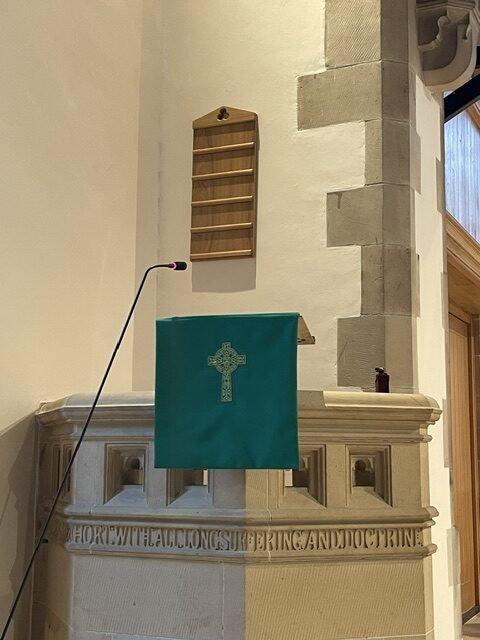
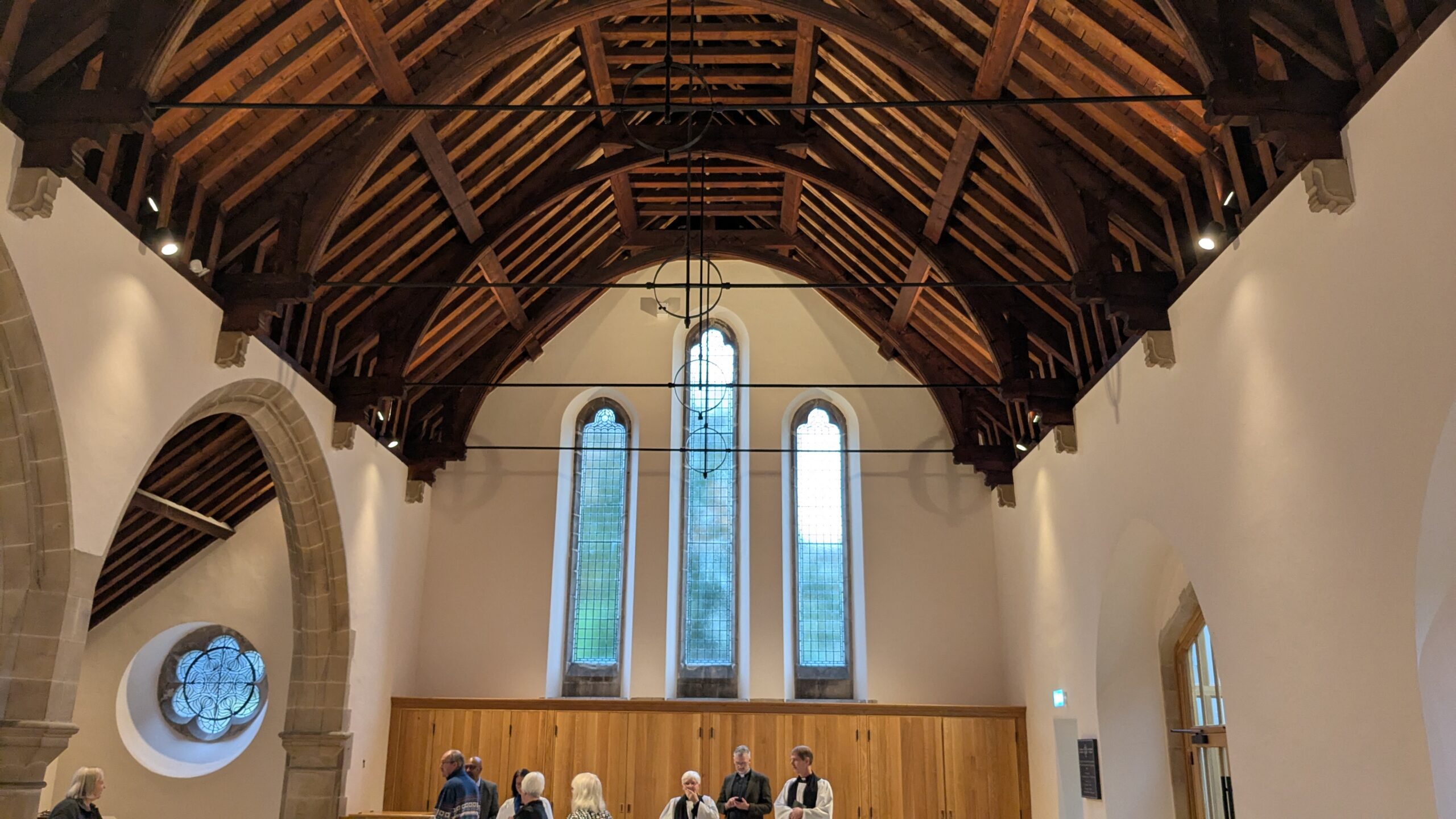
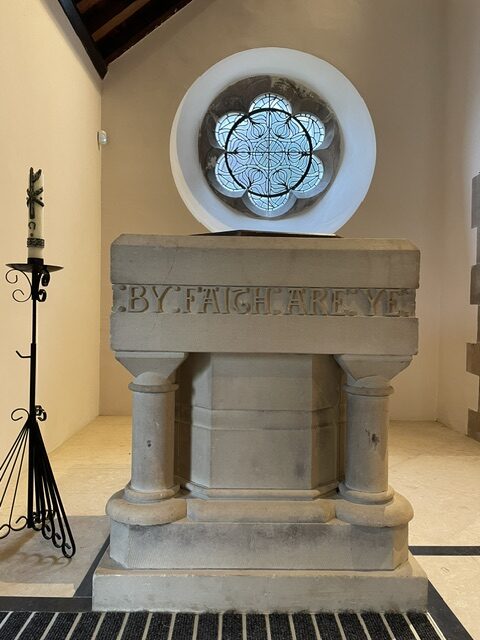
Most recently, in July 2023, an ambitious programme to improve the interior of the church was completed. At a cost of £700,000 the facilities including toilets and kitchen were modernised and extended; a sophisticated audio-visual system was installed. New seating and furnishings have transformed the nave and chancel. All these improvements mean that the present church is able to play an important role in the local community offering its facilities to a wider range of people.

Contact us
Find usAll Saints Commercial St, Newtown SY16 2BW.
Call01686 951395
EmailChrisTurner@cinw.org.uk

